The Matchcover Storyteller
Let’s start with Eagle Mountain Lake itself. It’s in Texas, for a start, a bit north of Fort Worth. Originally a reservoir and now also a popular recreation site, it was formed between 1928 and 1932 by damning the west fork of the famed Trinity River.
But this is about the Marines. They enter the scene in 1942 when nearly 3,000 acres of land were purchased for a Marine Corps Glider School. “$5,000,000 Glider Base Here OK’d” was the huge headline in the Fort Worth Telegram on June 23rd, 1942. Touted as the first of its kind, It opened in December 1942 —
–and closed in May 1943! Hastily built, the original intent was to play off of Germany’s remarkable glider conquest of the island of Crete in the Mediterranean. The Texas Marine Glider program lasted less than 6 months!
The base became a Naval Air Station (another matchcover!) but then reverted back to the Marine Corps in 1944.as a dive bombing school. In December of 1944 Eagle Mountain Lake became a night fighter school. Primary aircraft for you buffs were the Grumman F6F Hellcat and the F7F Tigercat.
After WW II in 1946, the base went into caretaker status and then an outlying field for NAS Dallas. The Texas Air National Guard and other tenants followed before the base was sold to private interests in the 1970s. In 1981 the 33-acre site became the privately-owned public use Kenneth Copeland Airport. It’s owned by Kenneth Copeland Ministries; he’s a quite “successful” televangelist. His massive church, television and production studios and offices are all there.
There were 121 aircraft on the base at the height of Marine Corps Air Station activities in 1944; Copeland has 4 of his own there today and the old runway is now used only for small planes..
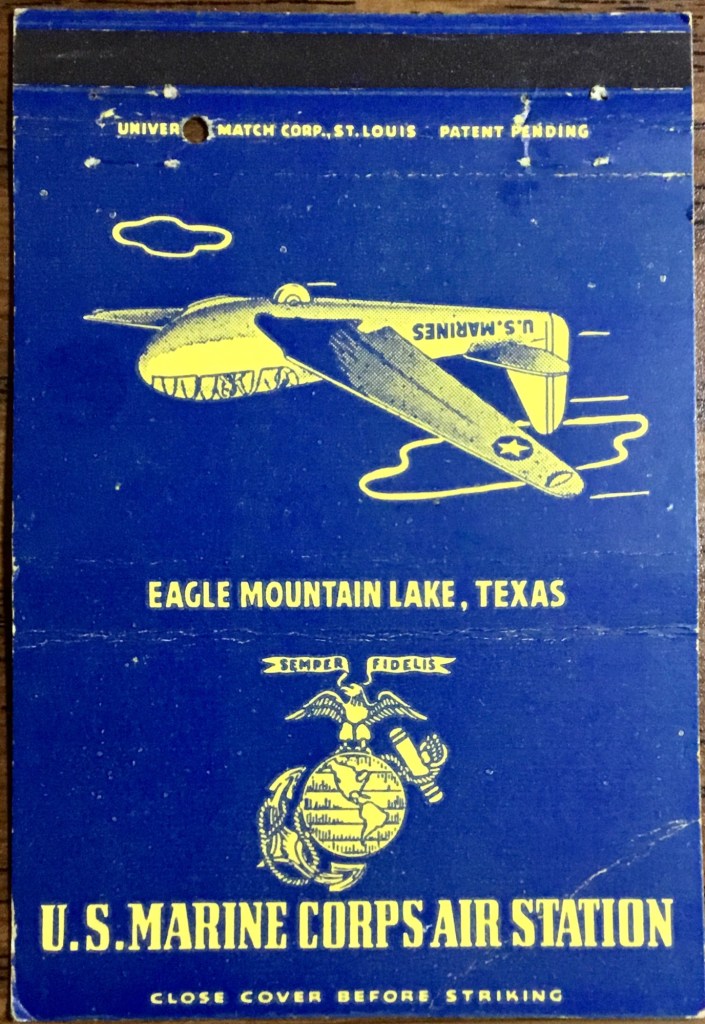
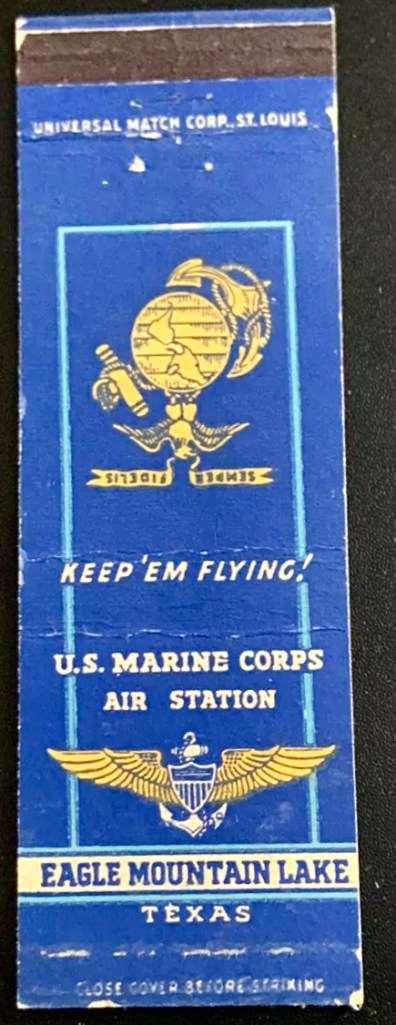
The most common matchcover for this site is a Universal 40-strike, blue & gold pictured above. It’s most likely from 1943 when the glider program was in operation. But there are other USMCAS Eagle Mountain Lake covers as well — 20-strike, including one when it was briefly the Naval Air Station in 1944
As Eagle Mountain lake became an auxiliary field for Naval Air Station Dallas, it had its own auxiliary field a few miles north at Rhome, Texas. Interestingly, that’s where the Texas Historical Society has put a marker plaque.
Among the vagaries of a modern 21st century televangelist complex, there remains the weathered airstrip lined with some gas pads and with an abandoned Quonset hut hanger at the far end. — the only signs of what was once going to be “the first of its kind”, but also what is described in multiple sources today as a facility “that helped win World War II”.

 The Matchcover Storyteller