The Matchcover Storyteller
Let’s start with the attack on Pearl Harbor on 7 Dec 41. Many accounts make it sound like it just happened and then poof! itwas over. Not so — that attack lasted more than 3 hours with Japanese planes overhead. Sailors on the destroyer U.S.S. Mugford know — they shot down 3 of them between 8:07 a.m. and 9:28 a.m. Then, in the chaos of that morning, she was still able to refuel and get out of Pearl by 12:35, just 5 minutes after watching one more enemy plane crash on the beach at HickamField.
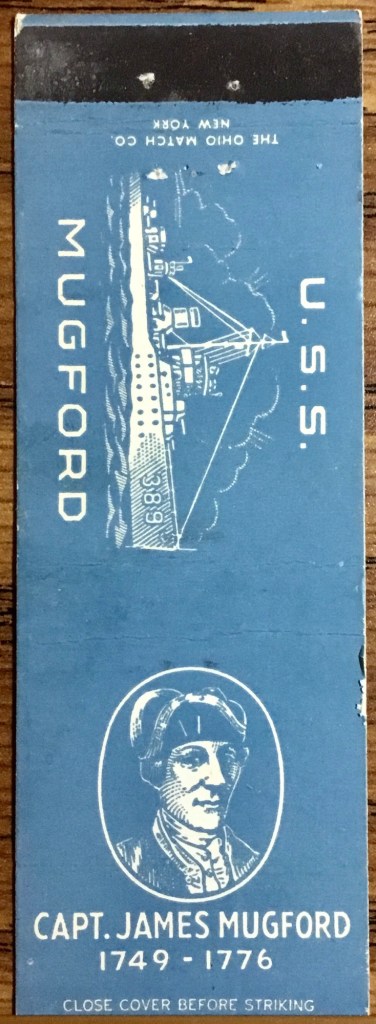
For you collectors, that makes the Mugford a pre-war navy ship. If you want to be cool, they called her “Mugs”. This 20-strike, front striker is the only cover I have for her. It’s from The Ohio Match Co in one of its earlier production sites in New York.
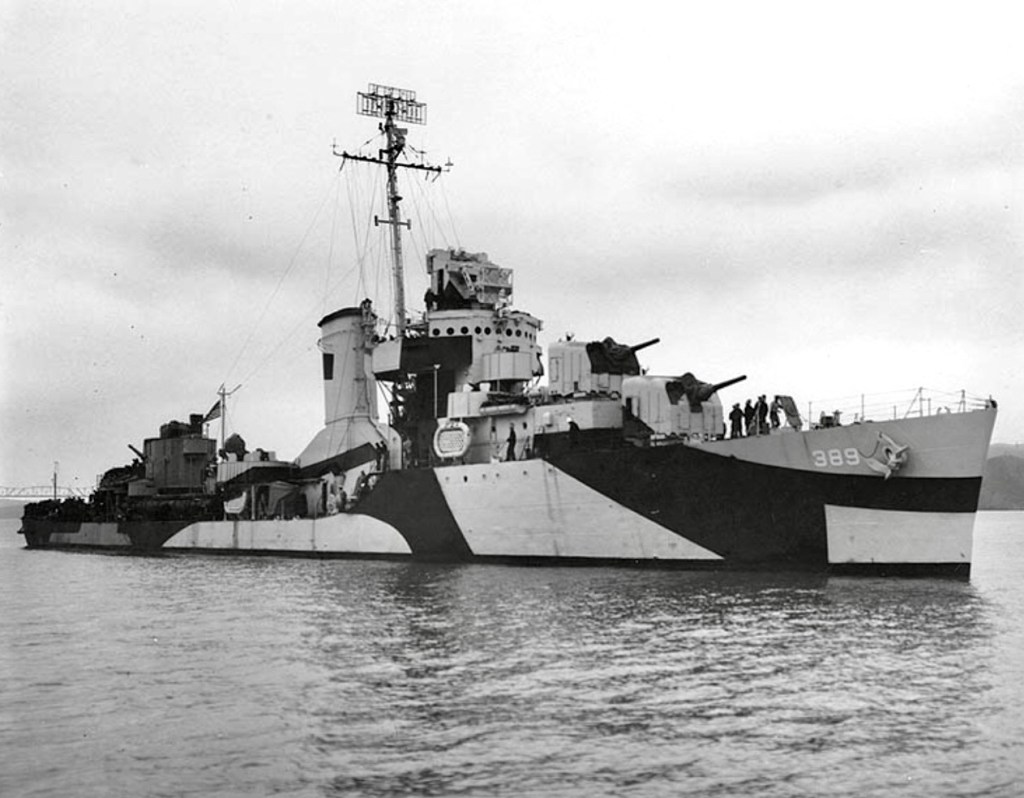
U.S.S. Mugford, DD-389, was the second ship in the U.S. Navy to bear the name. She was a Bagley-class destroyer, one of 8 ordered in 1935 and completed in 1937 in Boston. She joined the Pacific Fleet that year, quietly patrolling the eastern Pacific until rising political tensions saw her shifted to Pearl Harbor, Territory of Hawaii. In 1940, all of her gun crews received the “E” for excellence ships are proud to display; they had all achieved perfect scores in a shooting contest. I think that was evidenced on Dec 7th. The plane shoot-downs I alluded to earlier were all courtesy of Mugford’s .50 cal. machine guns!
In 1942 she was part of the abortive relief attempt for Wake Island. Then, at Guadalcanal in August 1942, she took a bomb hit on her stern, killing 8 sailors. She claimed 2 or 3 more enemy aircraft in that battle, suffered near-misses in more attacks and rescued a pair of downed enemy pilots. The following day, she rescued more than 400 sailors from the sunken USS Vincennes and USS Astoria in the Battle of Savo Island.
“Mugs” was repaired in Sydney and back on patrol in the fall of ’42; I want to say at this point that there are some great detailed histories of her career, not just in Wikipedia but in several other naval pages as well. The late war years saw her escorting the battleship Maryland to Puget Sound, doing some patrolling and then finally radar and picket duty back in the war zone of the western Pacific from March 1945 to the end of the war.
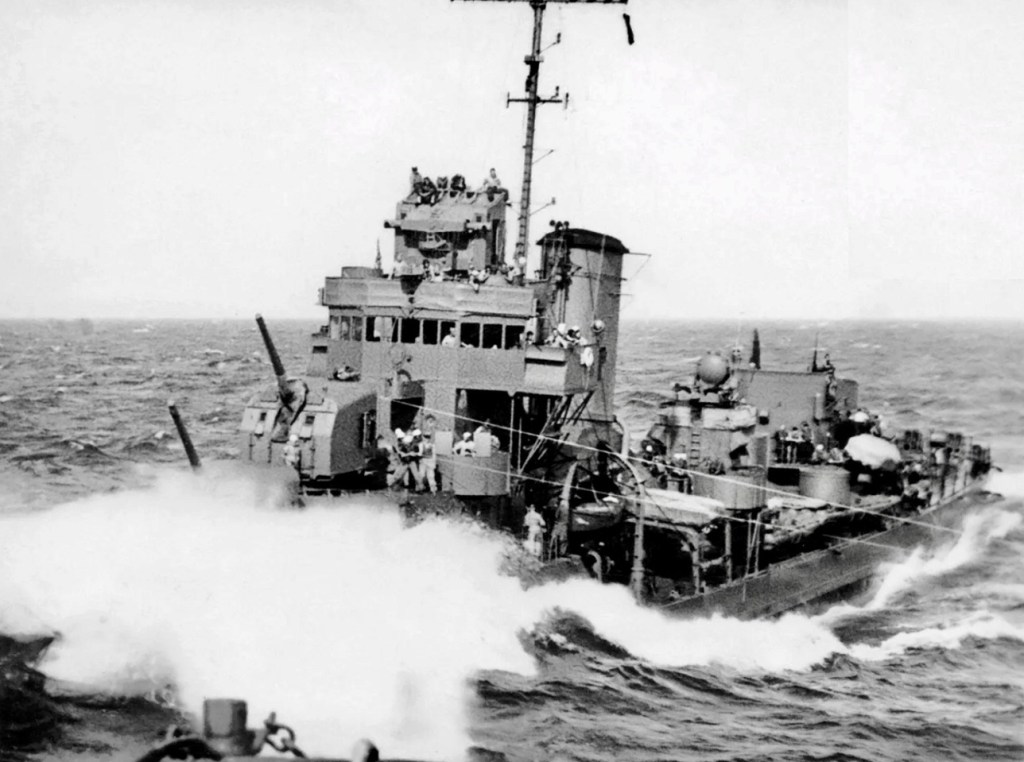
I’d like to think that she was proud of one September 1945 assignment, transporting liberated Allied POWs from Japan to Okinawa before they went home. “Mugs” continued screening carriers and providing air defense until returning to San Diego in March of 1946 where she was stripped and made ready for the atomic bomb tests at Bikini Atoll — the first since the testing in July of 1945 and subsequent use at Hiroshima and Nagasaki. Operation Crossroads was an examination of nuclear blasts on warships; USS Mugford was again part of a large fleet one last time.
She was finally decommissioned in August of 1946, but retained for experiments in nuclear decontamination, and then finally scuttled off Kwajalein in March of 1948.
So finally, a couple of things: the first U.S.S. Mugford, DD-105 was a Wickes-class destroyer commissioned in 1918, decommissioned in ’22 and sold for scrap in ’36.
So, who was their namesake? He was Captain James Mugford(1749-1776) of the fledgling Continental Navy. There’s some exciting pre-story to his life, but in 1775, his schooner Franklin captured a British ship, the Hope, with a large cargo of military stores and powder. He got her into Boston Harbor right under the noses of His Majesty’s British Fleet. Then in May of ’76, the Franklin itself was boarded by a group of Britishers claiming to be friends from Boston. Mugford was killed in the ensuing action, the only American officer to die.

He’s buried in Marblehead, Massachusetts
 The Matchcover Storyteller