The Matchcover Storyteller
In the Military Corner, we can salute great warships, mighty armies, air armadas and the like, but maybe once in a while, the place where a soldier or sailor can just chill can be as vital to the nation in its own way! So:
The Seven Seas Club was one of 4 enlisted clubs on base at Naval Air Station, Memphis Tennessee; it was probably the largest and most “famous” as the club for all-hands, primarily catering to the lower grades, E-1 to E-6. The others were the Acey-Ducy Club for E-5 & 6 (2nd & 1st Class Petty Officers) and the Chief Petty Officers (CPO) Club for E7 through 9, the latter strictly off-limits to sailors below those ranks. (In later years, there was also The Liberty Center for very junior (E-1 to E-3) sailors.
Memphis Naval Air Station was created in 1917 as Park Field, a fledgling aviation school for the Army Signal Corps. The Navy arrived in 1942; the base became Naval Air Station Memphis in 1943, and the Seven Seas Club opened that same year. NAS Memphis was described as “the largest inland naval base in the world”, operating until 1995.
NAS Memphis, home to the Naval Air Technical Training Center, based about 10,000 personnel during WW II; in the Cold War of the 1950s, the population was 10- to 13,000 and the base reached its peak during the Vietnam conflict — in the late 60s and early 70s, it had up to 18,000 permanent personnel on the ground, and some 23,000 students passed through every year. Today, since base realignment in 1995, the base is the Naval Support Activity Memphis (actually a bit north in Millington, TN.)
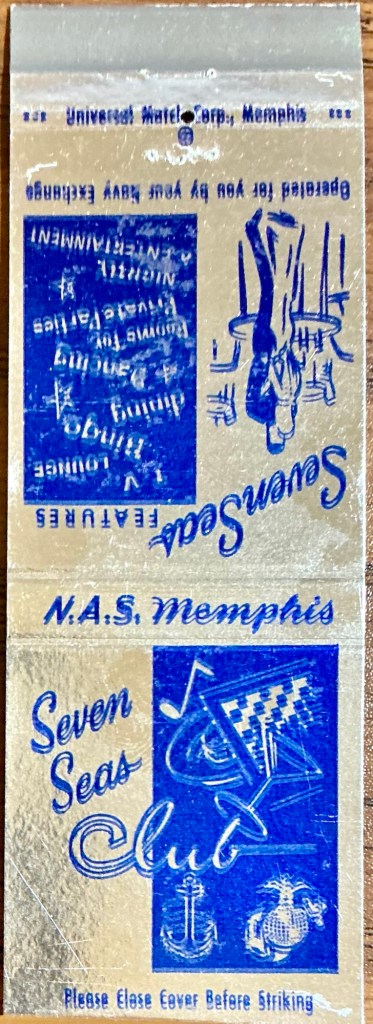
In its heyday, it’s estimated the Seven Seas Club could hold up to a thousand people, including 300 to 400 in one ballroom. You may note the back of the matchcover lists “TV; a lounge; dining; bingo; dancing; nightly entertainment and rooms for private parties”. With 18,000 on base during Vietnam, it was often “standing room only”: with lines out the door. Veterans often remember it as “the biggest in the Navy”. The Seven Seas Club was eventually replaced by the larger and even more versatile Helmsman Club. Then at the end of its time, in 1992 at the start of base realignment, the club made some headlines witha second life — they were singing hymns, not drinking songs. The physical building was given over to a small local church congregation. Today, even the physical structure is gone.
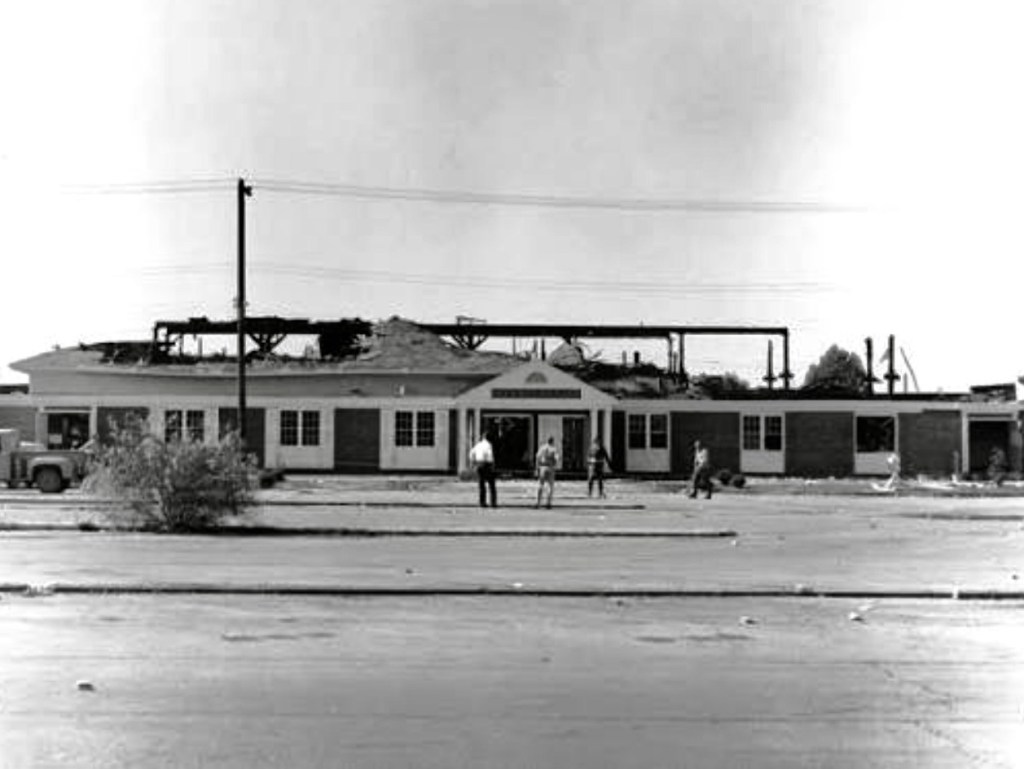
Because NAS Memphis was so large, it was a significant stop for touring USO shows; the club also held the occasional “smoker”, unauthorized boxing and wrestling matches that often involved the sailors themselves.
Enlisted clubs like the Seven Seas Club were the social glue of a military life, a bridge between rigid discipline and humanconnection.. They go all the way back to the old post trader days in the 19th century, but started to evolve in the 1890s when the then-War Department replaced traders with post exchanges. Then the real expansion of the club system happened during the two world wars. They were vital for morale and mental health; balance among certain rants and safety control – reducingAWOL rates, monitoring alcohol consumption (not always successfully, I can attest) and some element akin to home comfort. In the modern military, the prominence of the EM club has faded somewhat.
This was the only Seven Seas Memphis cover I have or could find. There are other Navy Seven Seas Club matchcovers, notably at San Diego and a civilian nightspot in Hollywood.
.
 The Matchcover Storyteller