The Matchcover Storyteller
Without doing a really deep information dumpster dive, there is just not a lot of available information on The Colonel’s Restaurant. In fact, even the most vigorous internet search is going to keep taking us back to “The Colonel” himself: — Harland Sanders and Kentucky Fried Chicken.
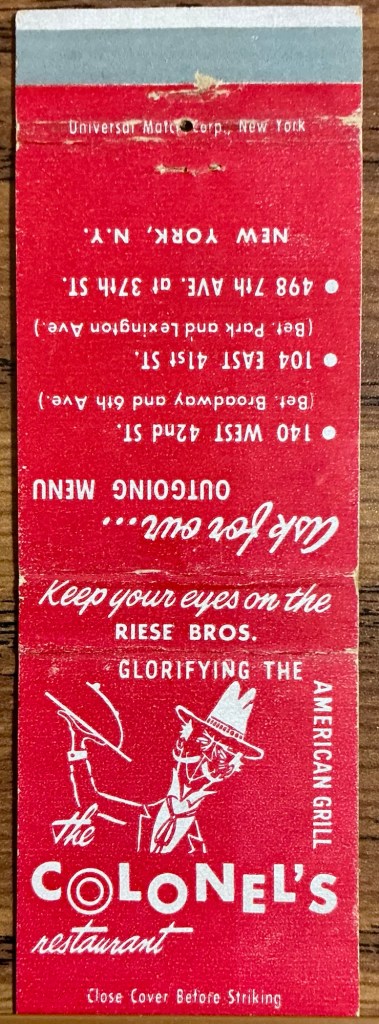
This one, however, is older and part of a conglomerate that has been around for more than 7 decades. There were three “The Colonel’s Restaurant”s in New York City — at 140 W. 42nd Street, just off Times Square; at 104 E. 41st Street near Park Avenue and Grand Central Terminal, and at 498 7th Avenue, about 3 blocks north of Madison Square Garden.
And that’s all there is, except that they were owned by the Riese Brothers, who do have history.
Brothers Maurice and Irving Riese were born in Harlem and started as dishwashers before they opened their first luncheonette in Manhattan in 1940 for about $8,500 (around $202,000 today). Five years later, they sold it for a whopping $38,000 (nearly $916,000 purchasing power today!) In that moment, they realized owning was better than operating, and went into the business of flipping troubled eateries and refurbishing them. As Maurice (Murray) put it, “Why sell sandwiches for a dime when you can sell a restaurant for $38.000?”
They kept acquiring through the years and by the 1980s it was estimated that they owned some 300 restaurants and fed half a million New Yorkers every day. The brothers might close a restaurant on a Friday night and open it Monday under a new name. Maurice is also credited with creating the food court concept of clustering of restaurants; he could shoehorn restaurants together in the same small space.
Today, it’s called the Riese Organization, heavy in real estate along with restaurants galore.
Irving died in 1990, Maurice in 1995.
The thing to look for on a matchcover, perhaps, is the name on the saddle — “Keep your eyes on The Riese Bros.” It’s not something I paid attention to until I recognized the scope of their holdings: a lot of fast food franchises of names like Roy Rogers, Dunkin’ Donuts, Houlihans, T.G.I. Fridays and lots, lots more. While chains dominated later on, it is these earlier, mostly forgotten or unidentified smaller restaurants where a Riece Brothers accumulation might be an interesting small collection.